Author: Gershon Ben Keren
My father was an angry and sometimes violent man. As a child I never bothered to understand why as I recognized that I was powerless to change him, and by gaining an understanding as to why he was that way, I might have become sympathetic to him, and excuse his outbursts etc., something I wasn’t ever prepared to do. To be accurate, labelling someone as being “violent” isn’t completely fair, as my dad did have some positive personality traits, it would be better to describe him as someone who had a predisposition to anger, aggression and violence i.e., he would react angrily and read neutral situations/interactions as requiring an aggressive response etc. Unfortunately, there are many people like him, and many of us have experienced individuals overreacting to situations where there was no actual challenge or threat to them. The tendency of individuals who are predisposed to violence, to perceive threats in situations that others would interpret as neutral or benign, is one of the most consistently documented findings in the psychology of aggression. It sits at the intersection of cognitive science, developmental psychology, and criminology, and has significant implications for understanding, predicting, and ultimately preventing violence. In this article I want to look at some of the research into this, and the theories and models that resulted from them.
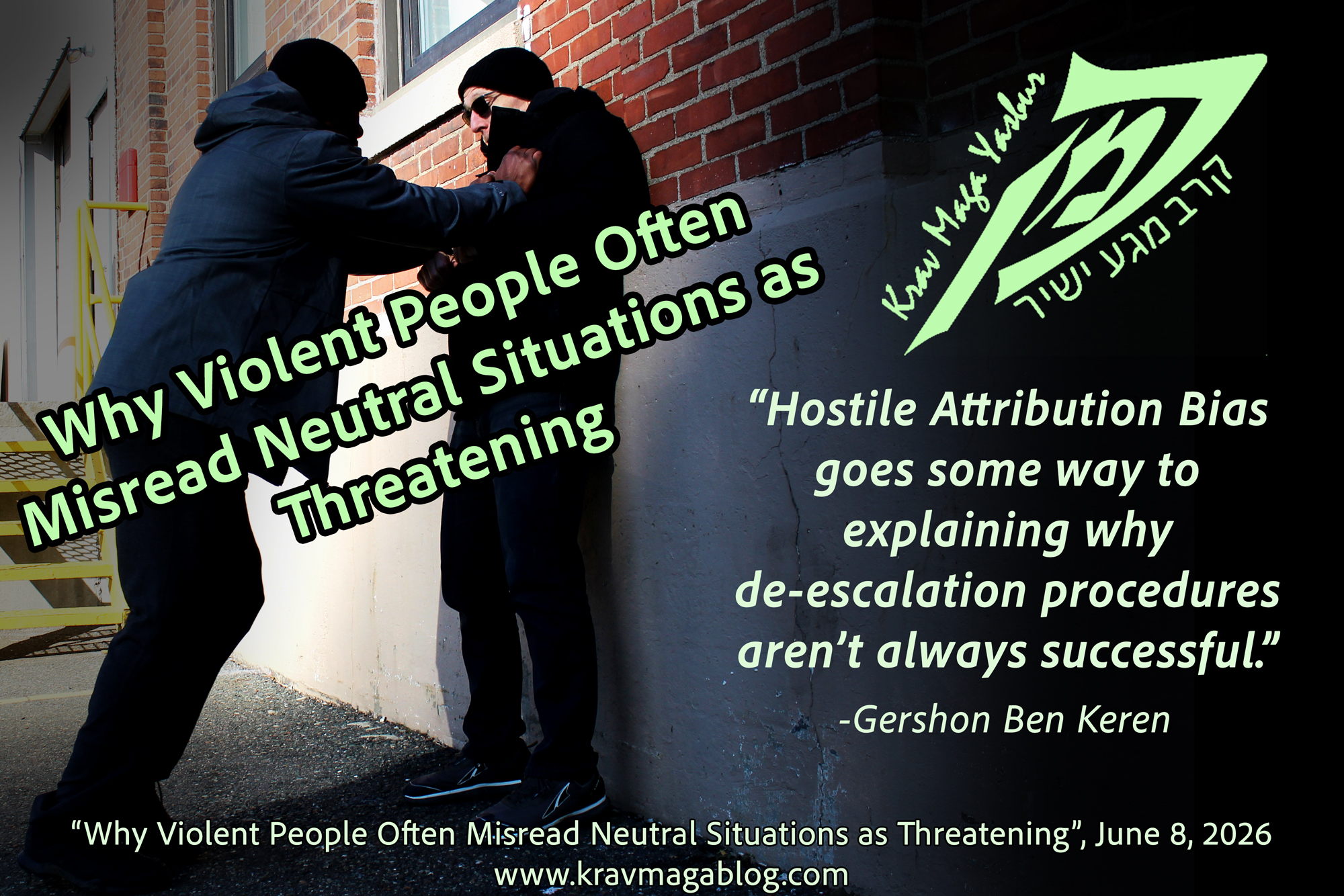
Hostile Attribution Bias (HAB) was a concept/idea/theory that was developed by Kenneth Dodge in the 1980’s. He conducted two in-depth and rigorous studies looking at aggressive children, demonstrating that when presented with ambiguous social cues, such as being bumped in a corridor or a peer taking a toy away from them, aggressive individuals consistently interpreted the other person's intent as hostile even when the situation permitted multiple plausible, and more realistic, interpretations, whilst “non-aggressive” children were far more likely to attribute the same event to an accident or cluelessness etc. This goes beyond a simple reaction i.e., these individuals aren’t simply responding differently to the same stimulus they are, in a somewhat meaningful psychological sense, they are experiencing a “different” situation. Their cognitive processing has pre-classified the social event as hostile before any deliberate analysis has occurred. Hostile Attribution Bias goes some way to explaining why de-escalation procedures aren’t always successful. Whilst many people want to find a way out of a verbal confrontation that has developed out of a dispute or a frustration, there are those that don’t want to. These are the individuals who can see no alternatives other than acting violently. Such individuals have already assumed bad intent and aren’t open to considering other explanations that may exist. This is why any attempt at de-escalating a situation must be done from a physical position that allows you the space and time to respond to a physical assault.
From his work that led to Hostile Attribution Bias, Dodge developed Social Information Processing (SIP) theory. The theory proposes that people move through six sequential mental steps when responding to social interactions, with those who are predisposed to aggression and violence often processing information differently at one or more of these stages. The first step is the Encoding of Cues e.g., the individual notices and selects information from the environment, with aggressive individuals focusing heavily on threatening and/or disrespectful cues whilst ignoring calming and/or neutral ones. The next step involves the Interpretation of Cues, with the individual deciding what these cues mean. This is where hostile attribution bias often features with seemingly ambiguous actions/cues being interpreted as intentionally hostile/threatening. After the cues have been interpreted the Clarification of Goals occurs. In this phase the individual decides what they want to gain from the interaction. Such goals may involve revenge, dominance, saving face, or simply avoiding humiliation etc. In de-escalation, this is the stage where you attempt to get an individual to consider alternatives to acting violently, however this can only be done if you have reduced enough of their emotional state for them to think somewhat rationally (part of this involves affecting their interpretation of cues so that they see you as a non-aggressor and someone who wants to resolve the situation non-physically). Once their goals have been clarified they mentally generate possible responses, a phase referred to as Response Access/Construction. Someone who has had a long exposure to violent or aggressive environments, either as an aggressor or as a victim, may have a limited range of responses available besides responding aggressively/violently. At some point they will reach a Response Decision where they evaluate the possible responses and select one, often internally trying to answer questions such as “will this work”, “what are the consequences of me behaving this way?" etc. The final stage is Behavioral Enactment where the chosen behavior is carried out/executed.
I used to see this process occur in real-time when I was working pub/bar/club security. On a fairly regular basis you would see someone accidentally bump into another person as they were carrying drinks back to a table. Using (SIP) we can work through the process. The first step is the bumped individual noticing the physical contact and the spilt drinks (the Encoding of Cues). Next, they interpret it (Interpretation of Cues) as deliberate disrespect rather than as the accident it was, possibly due to Hostile Attribution Bias, with their goal (Clarification of Goals) now becoming about restoring status and avoiding humiliation in front of their friends etc. They then consider their actual responses (Response Access/Construction) such as ignoring it, verbally confronting the person, or possibly responding physically immediately. This is where you often see people pause for a moment, and when it happens it normally is a fairly good pre-violence indicator (PVI). They then decide that violence is the best/only option (Response Decision) because they believe that backing down will make them look weak in front of their friends, so they take a swing at their transgressor or push them etc., (Behavioral Enactment) and the fight starts.
SIP theory is important in Self-Protection/Personal Safety training as it demonstrates that violence is often not purely impulsive or irrational. Instead, aggressive behavior(s) can emerge from distorted interpretations (perhaps due to a hostile attribution bias), learned expectations, emotional arousal, and social goals, that occur during everyday social interactions. This is why de-escalation should be proactive rather than reactive, setting the stage for a non-violent resolution, at the very earliest moment in this chain.