Author: Gershon Ben Keren
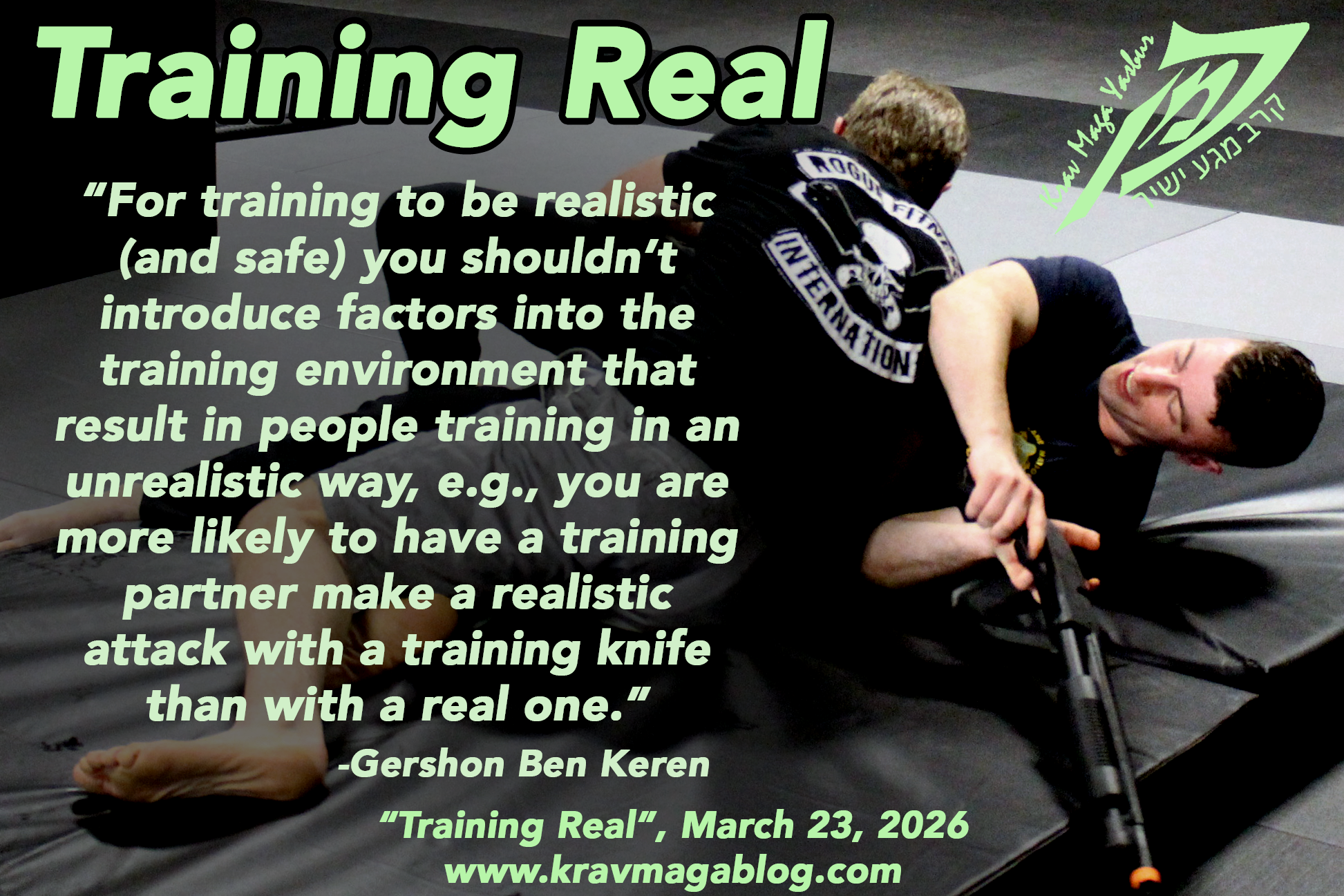
There’s a certain “school of thought” that says you should only train how you should/would fight in a real-life situation. I would argue that there are times you should do this – within safety parameters (or what’s the point of “training” you might as well just wait for a real-life attack as that’s what you would be experiencing etc.) – but not all the time. To take the idea to the extreme, I didn’t wear my Judogi when I ran or lifted weights which were all part of my training regime when I was an active competitor, neither did I when I was working certain Judo drills. When I was building and developing certain skills it would have gotten in the way, and this was in a combat sport where the GI itself was the “focus” of everything. Equally I wouldn’t want to “develop” my kicking ability in a pair of jeans as the lack of movement that they would provide would restrict my ability to learn how to develop power in my kicks. Yes, I should experience how kicking can be restricted by clothing but that should be discovered after I understand the dynamics and mechanisms of a kick i.e., what I need to overcome and adjust for etc. When I learnt mathematics at school, I didn’t just learn how to calculate change and divide a pizza between a certain number of people etc., I learnt it so I could understand other things and apply my math to different situations. In this article I want to look at why training should always “reflect” rather than try to replicate reality, as doing so can often actually take away from the “reality” of the training.
Live Knife/Weapon Training
I have encountered instructors who are all about live weapon training e.g., that students should always be using a live blade etc. Whenever I have seen real/actual knives used in training or demonstrations, the movements/attacks have been slowed down and/or choreographed in a way, and to a degree, where they don’t resemble real-life attacks. This is perfectly understandable and makes sense i.e., you don’t want practitioners to injure or potentially kill others by making repeated, committed and random stabs and slashes against their partner. There is a reason that “training” weapons exist and to be honest the less injurious they are – if they connect – the more likely it is that a “real-life” type/style of attack will be made. In my school I have both rigid, semi-rigid and foam knives that I use to try and replicate reality as closely as I can without jeopardizing the safety of those that train with me. I want my students to make and experience realistic threats and attacks and using a live blade isn’t going to accomplish this i.e., everybody – for safety reasons – will hold back.
I know of one Israeli instructor – not working/living in Israel - who around twenty years ago accidentally shot one of his students by training with a live firearm. On the set of Rust in 2021, a live round fired from a prop gun Alec Baldwin was holding killed cinematographer Halyna Hutchins and injured director Joel Souza. This was clearly an accident and mistake, which doesn’t mean that nobody was liable or responsible and shouldn’t have been held responsible etc., but such an accident is very different to an instructor in a self-defense scenario using a loaded/live weapon in training i.e., not checking and/or not caring if it was loaded etc. In such a training environment if it was decided that a “real” weapon should be used, so that somebody got a look and feel of what a real firearm disarm experience with be I would a) advocate using a training weapon that was weighted to match the firearm it was replicating, and b) if you decided that you’d use a real weapon (and I’m certainly not advocating this approach) take every step to make sure it wasn’t loaded. It may be more “real” to use a loaded weapon, but if this is the way you make it “real”, there is something lacking in your training/instructorship.
Training in Street Clothes
I’m not saying there isn’t a benefit to training in everyday clothing including footwear etc., but many times I see watch videos of classes/seminars where the students/participants were training in their “street clothes” there was no purpose to moving from training gear/attire to normal clothing e.g., nobody was performing techniques or doing things where the clothing they were wearing mattered; it doesn’t really make a difference if you are throwing a hammer-fist in your Iron Maiden t-shirt or the one with your school logo on it etc. If the class involved scenario-based training in a real-life setting the change of clothing may add to the realism of the scenario, however if you’re simply performing combative drills in a dojo wearing a pair of jeans and a football shirt, I’m not sure anything different to regular training, is being achieved etc., and if someone does believe that the change of clothing, without changing the environment and scenario, makes what they are doing more “real” then their concept of real-life violence may be somewhat off.
Barefoot Vs. Shoes
I’ve written an article on this, and mentioned it in others, before. Ultimately, it’s an individual choice but the simplistic argument of, “I train in shoes because that’s what I wear on the street”, is certainly not a conclusive one. My school/training environment is fully matted as we teach/practice throws, takedowns and groundwork. The mats aren’t smooth but instead are intended to give a surface for your feet naturally grip too. On the street and in many other environments the surface you will be on is smooth e.g., concrete sidewalks and pavements are somewhat smooth. This is why your footwear has soles which grip and are non-slip (this is for that reason – sidewalks are inherently slippy). If you were to wear an everyday shoe on my mats, you’d be introducing two surfaces designed to grip, which doesn’t reflect reality, which is why on that training surface people practice barefoot. When we do environmental training outdoors, which is intended to reflect real-life scenarios, people don’t train barefoot. Simply putting on a pair of shoes/trainers doesn’t make training more “real”.
Conclusion
For training to be realistic (and safe) you shouldn’t introduce factors into the training environment that result in people training in an unrealistic way, e.g., you are more likely to have a training partner make a realistic attack with a training knife than with a real one. When you look at and consider how professional military personnel introduce live firearm training there is little “mayhem”; it is controlled, often slowed down in moments of a drill for safety purposes, and there is an instructor/range master, assisted by others working through the drill in a controlled manner. I have seen videos where people have been used rather than mannequins/dummies, where the use of which wouldn’t have made a difference. Scenario/reality-based training is great and a useful tool to reflect “reality” but simply putting on street clothes (including wearing shoes) and taking part in a “regular” class wearing different attire isn’t the same as this.