Author: Gershon Ben Keren
When I used to compete in Judo, I knew what to expect e.g., I knew how to win the fight, what the rules were, how long the “fight” would last for, and if I was competing locally/regionally I often knew the people I’d be competing against. All of these things allowed me to make “trained” responses i.e., I could set up throws, work towards submissions on the ground etc. However, real life violence is very different; there is no referee to stop, start and adjudicate the fight, there are no rules that specify how the other person will fight, and it’s extremely unlikely that you know how the aggressor is likely to go about trying to dismantle you i.e., there are a lot of unknowns. This means that a lot of your “trained” responses aren’t – at least initially – likely to work. It is unlikely, unless you set things up correctly, that you will be starting the confrontation in your “fighting stance”; in fact, if you had time to get into one, you may have missed an opportunity to disengage or throw a preemptive strike etc. This is one of the reasons why it is important to practice getting into a fighting stance if/when attacked from any direction. In most cases your initial response will be an untrained/instinctive one, and it is important to acknowledge and understand this, along with not over-estimating your abilities to respond, initially, in a way that will end the fight and/or give you an advantage.
The fact that Krav Maga teaches/trains defenses to attacks from an “Unprepared Stance” acknowledges the reality that there are times when we are caught by surprise. I would argue that even when we recognize that violence is inevitable and that we need to physically defend ourselves, when an attack is initiated, we are still caught somewhat off-guard; as a species we are by nature optimistic creatures who hope for the best regardless of the reality we are dealing with. If we are caught by surprise – in whatever capacity – it is unlikely that we will make a trained response. Professional MMA fighter, Anthony Smith, said of a fight he had with a person who broke into his home, that it was “one of the toughest fights” he'd ever had, despite having a 30-to-35-pound weight advantage, and years of training. The fight lasted around five minutes and was stopped/broken up when police turned up. It’s all too easy when reviewing such incidents to conclude that Smith’s “techniques” that worked in an MMA context were inadequate for reality, and that he didn’t posses the survival skills necessary for the street etc., however this is nonsense. It is far more likely that Smith, despite his training, was “surprised” at having to deal with an aggressor in this particular context; he was used to fighting in a ring, with time to switch on his pain management systems etc., not being woken up in the middle of the night and having to deal with an intruder in his kitchen. Trying to implement “trained” responses in this unfamiliar context is extremely difficult and isn’t a reflection of his actual fighting skills and abilities.
Most people, when attacked, will respond instinctively i.e., they will make an untrained response; they will flinch, turn away, cover themselves, etc. Years of evolution have found these defense mechanisms to be the most effective way of dealing with an initial attack. When I watch CCTV footage of terrorist attacks, involving knife attacks, against Israeli citizens, I usually see – unless completely surprised – the person being stabbed, bringing their arm up to protect themselves, (if the knife is moving downwards) and attempting to move away to a lesser or greater degree. This is an instinctive response when confronted by such a movement. It doesn’t need to be trained as it’s instinctive/reactive. However, if a person hasn’t trained from this position, they don’t know what to do next, and so they often freeze, waiting for their conscious mind to take over and tell them what to do. Unfortunately, if untrained, their conscious mind doesn’t have the experience and/or a reference point to inform them as to how they should respond, and so they normally, at some point, resort to their “flight” response, turning away to try to get away from their attacker etc., resulting in stab wounds to their upper and lower back.
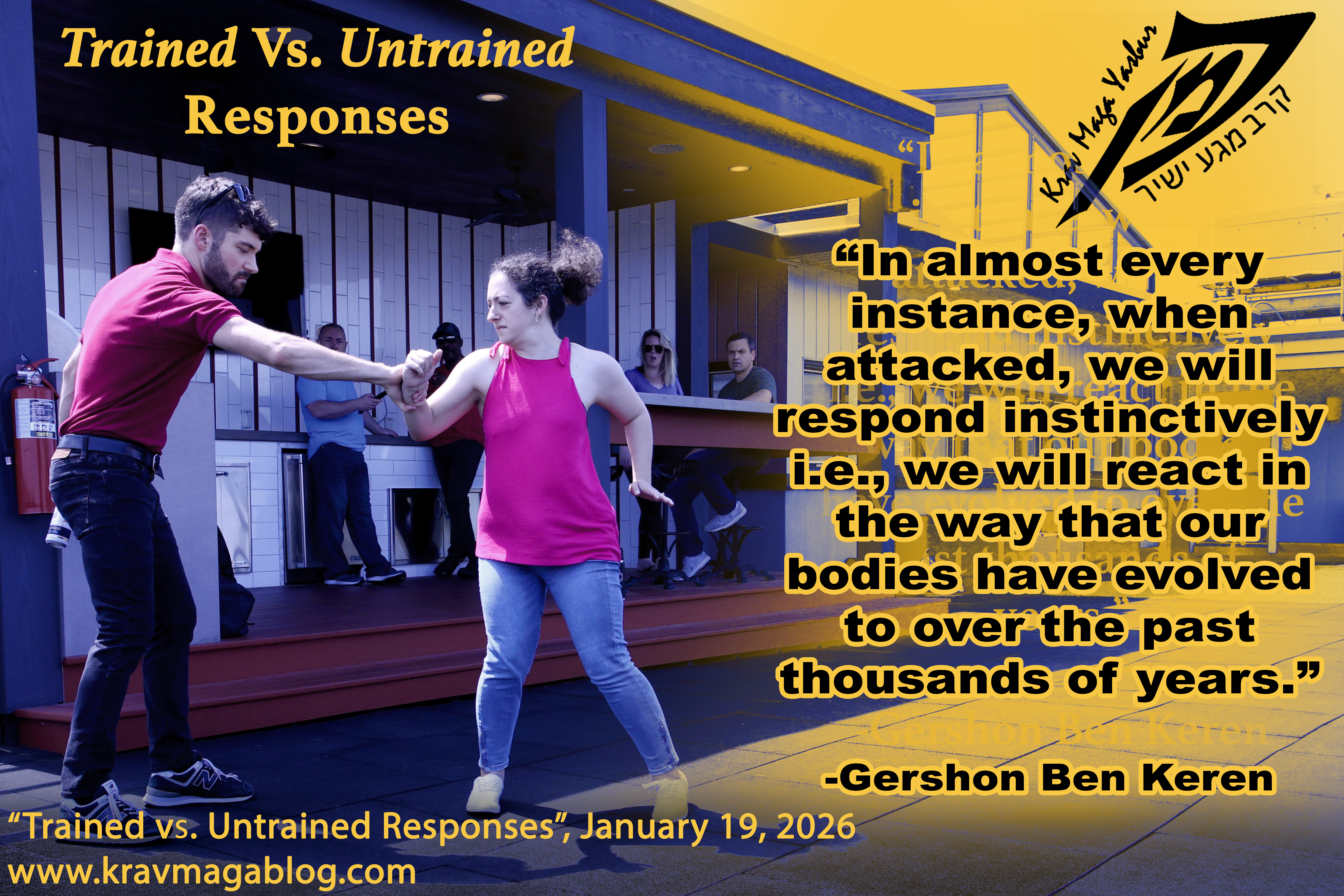
Many people “trained” in Krav Maga will believe that their training will immediately kick in when attacked in such a fashion, and that as well as blocking they will make a simultaneous attack i.e., because they have trained to respond in this way. I am not going to say that nobody will respond with a simultaneous block and attack when they are caught by surprise, as we are a strange species that enjoys exceptions but it is not something we should presume we will do; despite some apocryphal tale we have heard about a guy in Minnesota who when caught unawares, blocked and punched at the same time, whilst still holding onto his shopping bags, after being attacked coming out of a 7-11. In almost every instance, when attacked, we will respond instinctively i.e., we will react in the way that our bodies have evolved to over the past thousands of years. Our initial response will be an untrained one; one we perform naturally/instinctively without thinking.
This doesn’t mean that trained and untrained people possess equal/comparable fighting abilities. The difference is, not that the reflective/reactive response isn’t the same, as we all react in the same way, but rather that a trained person understands their reaction e.g., why they have brought their arm up, why they are moving away etc. The untrained person doesn’t have this reference point and doesn’t know what they should do next, whereas the trained person does. They understand the situation. They understand what their reaction means and this is where their “trained” responses should kick in; it is in this moment that they understand that rather than just blocking, they should attack as well.