Author: Gershon Ben Keren
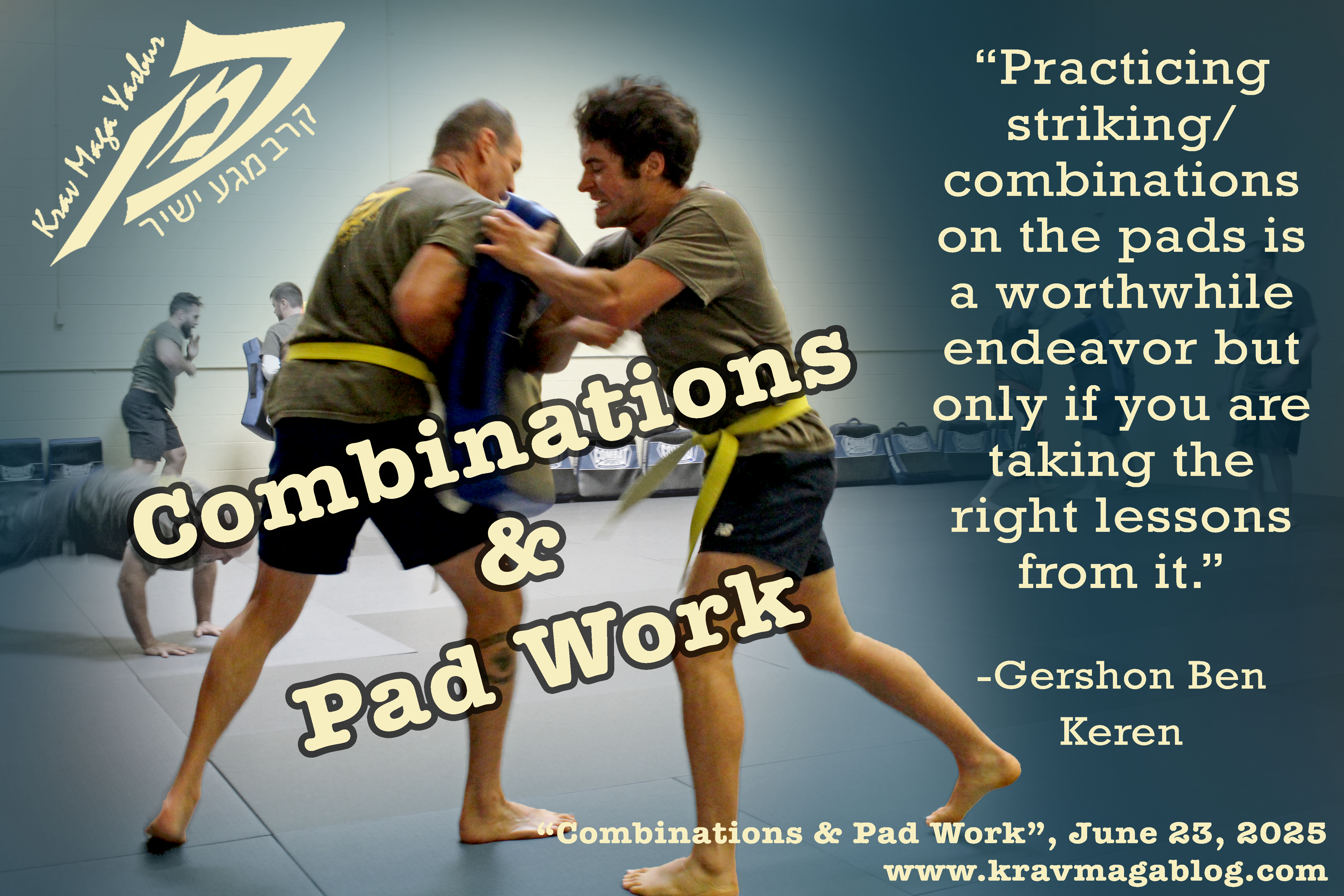
Whilst videos on YouTube and those posted on social media may give the impression that one-punch knockouts are common, the reality is that they’re not. There is also a huge difference between someone who, after receiving a punch goes down and gives up the fight – and there is no judgment on my part concerning this - versus someone who is actually rendered unconscious. The point being that if you believe you will end/finish a fight with one strike/punch you are engaging in “wishful” thinking. Equally, if you believe that you will immaculately execute the 1-2-3-4 combination that you practiced in the gym in a real-life confrontation you are mistaken, unless you perhaps have the skills of an Ali or a Tyson etc. This is not to say that practicing combinations on a bag or with a partner holding focus mitts doesn’t have its place but rather it’s important to understand the lesson(s) that this is teaching you. Believing that your prowess on the pads can be translated into dealing with a real-life, moving attacker, who doesn’t want you to be able to execute and display your fighting skills, can see you quickly becoming frustrated, as well as losing confidence and belief in your ability to be successful in a fight. Practicing striking/combinations on the pads is a worthwhile endeavor but only if you are taking the right lessons from it.
It’s very easy, and satisfying, to get caught up in the choreography of pad work. Despite being a default grappler, I have a love of boxing. I grew up in the UK, during the 1980’s, when boxing was a regular fixture on mainstream TV. It’s a sport I grew up watching, and one I took part in competitively during my later teenage years. Until I started practicing/participating in it, I didn’t fully understand the complexities and depth to it. Sometimes, it takes the experience of being in the ring with someone who knows what they’re doing to help you begin to understand what you don’t know. This is one of the reasons I advocate for people to train outside of their comfort zones, so that they can start to understand what they don’t know – it’s also the reason why I’m a believer in structured and formal academic education; it fills in the gaps you didn’t realize you had. I love watching pre-fight videos of professional boxers demonstrating their skills, whether it’s skipping, working a bag, or working the pads etc. I’m always amazed by their footwork, their reaction time, however I usually get caught up in watching the wrong thing: I get caught up with the choreography, rather than looking at the point of the choreography, and this is something I routinely see with people when they practice combinations whether on the pads or the heavy bag etc.
When someone first learns a combination, such as a jab, cross, hook, uppercut etc., it’s understandable that the focus is on the choreography i.e., the person wants to be able to make sure that they are completing the four strikes/punches in the correct order etc. However, in my opinion, this is not the point of learning the combination, as executing this sequence in this exact order, during a real-life confrontation, is extremely unlikely e.g., a person is unlikely to stay still or move in a way that allows you to do exactly what you want to do/have practiced etc. Practicing combinations, also rarely takes into account the “result” of a previous strike e.g., if you throw a successful jab that moves someone back this may mean that they aren’t in range for a subsequent cross etc. This is actually one of the reasons to practice combinations. If the jab is successful i.e., it produces a concussion and/or a disengagement opportunity, you don’t need to throw the cross, but if it doesn’t have an effect, you may need it to follow up with the cross and other strikes/punches etc. In some ways combinations can be seen as following up after a failure; how to seamlessly continue after an intended strike/punch didn’t land effectively/have the desired effect etc.
For me, one of the most important aspects of practicing combinations on the pads is understanding weight distribution and this is more important than learning the choreography of the strikes. This is the part of pad work that is felt e.g., if I throw a cross – from an orthodox stance – with my rear hand, my weight should be on my front/left foot, and I should feel/recognize this. It is this recognition that allows me to understand what power strikes/punches I can throw from here. If I have a wide enough stance, I can transfer weight laterally from my left foot to my right using a hook or elbow strike. That feeling/understanding of where the weight is and where it can be transferred to is extremely important for delivering strikes/punches with power. This is perhaps the greatest lesson that working the pads can teach us. If we can get to the point where we intuitively feel and know where our weight is, we can immediately know where it needs to be redistributed to in order to land a successive strike/punch that delivers maximum power. We may not have the option to deliver a “rehearsed” set of pre-programmed strikes – especially against a dynamic/moving opponent/aggressor - but if we can naturally understand how we can deliver a powerful strike from any position we find ourselves in we will always be able to know how to strike with maximum force.
Learning striking combinations shouldn’t be reduced to remembering a sequence of movements/strikes that we hope to pull off in a violent confrontation. Rather, we should learn to interpret where our body is in time and space and what this means for generating power. Rather than learning which punch, comes after which punch etc., we should learn to feel where our weight is and why a certain strike should come after another etc. Developing such a skill will enable us to intuitively know how we can generate power from any position in which we find ourselves.