Author: Gershon Ben Keren
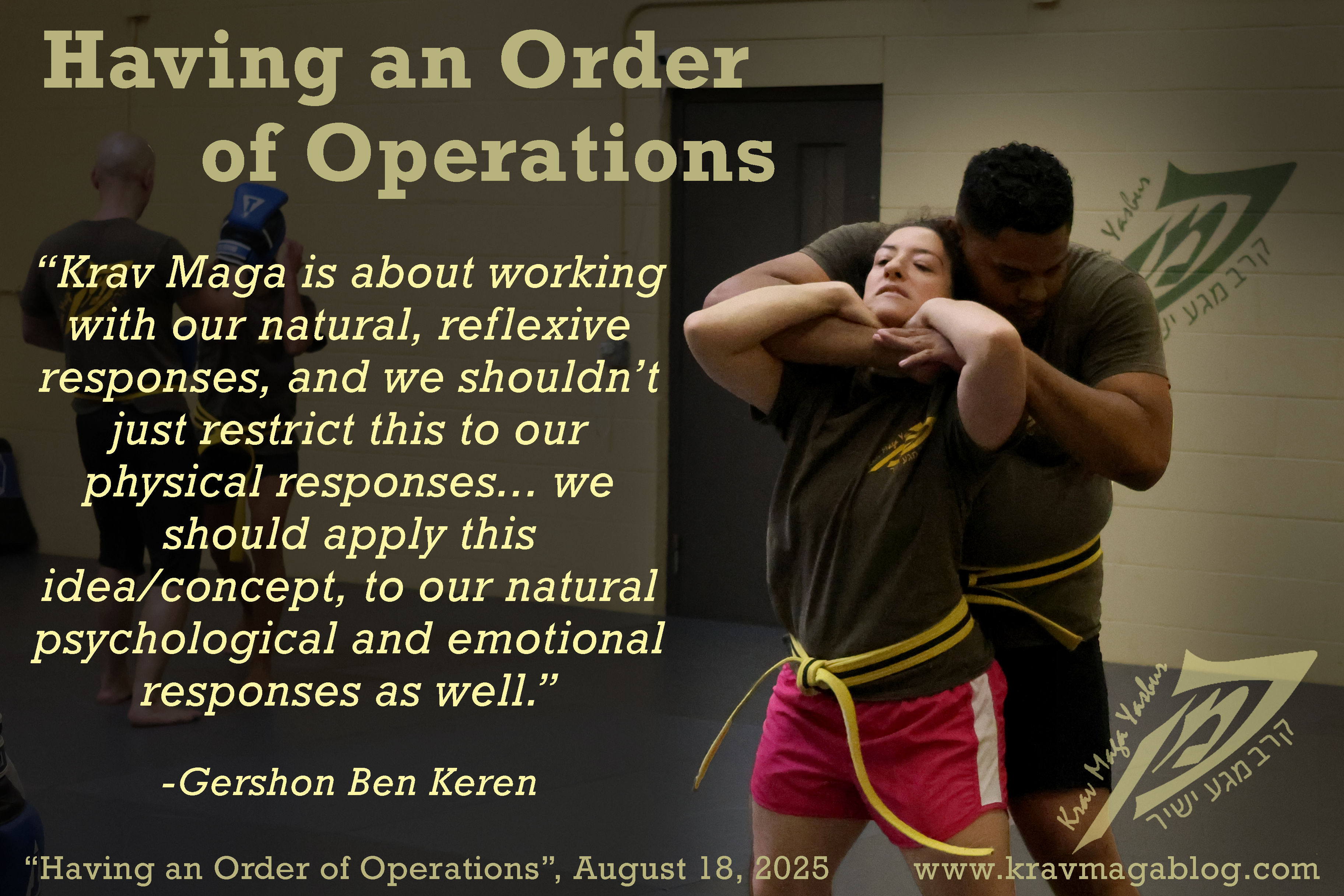
When training in a “controlled” environment, it can be easy to focus on the end result, rather than consider how we’d experience, and react to, a particular attack if it occurred in real-life. I often use a rear-strangle attack to illustrate this point. In a training environment many people will focus on the “escape” aspect, rather than recognizing that this won’t be a consideration if the attack is experienced in real-life. The first reaction will be panic, regardless of whether you are trained or untrained in how to deal with such an attack. The idea that you will immediately grab onto the attacking arm and pull/pluck down is unrealistic. When the airway is blocked, the initial response/reaction will be that of panic; ideally trained person will “recognize” what this panic means and start to initiate a solution, whereas the untrained person will likely continue to panic, however both experience the same panic. Training doesn’t make you immune to it, it simply allows you to manage it. If you don’t acknowledge this – natural – reaction, in your training, you won’t have an emotional reference point if it happens in real-life. It is by recognizing and training this panic phase, and the hands naturally coming up to scramble and pull the arm away in a panicked state, that you will actually be able to respond sooner.
As you “scramble” and begin to realize what is happening to you, you should turn the scramble into a “search” i.e., your hands should search for the gaps and spaces, where you’re able to grab onto your attacker’s arm. Depending on your attacker’s skill level and ability, these “gaps” will be in different places, and so training to simply bring the hands up and grab the arm in the same place every time is unrealistic and could see you failing to grab onto the arm/wrist if you only train this way. Attackers rarely make “cookie cutter” attacks each time – unless trained to do so (in which case you have a serious problem on your hands) – and so we shouldn’t train cookie cutter responses to them. This doesn’t necessarily mean that we need a variety of different techniques and solutions to deal with a particular attack, but rather we need to recognize that an attack can be experienced in somewhat different ways. The idea of quickly and cleanly coming up with the hands and immediately pulling down is an unrealistic one. It’s reassuring and satisfying in the training environment, however as Mike Tyson once famously said, “everybody has a plan until they get punched in the face.” Being strangled and unable to breathe is a metaphorical punch to the face. If we don’t recognize this and build it into our training, then we are not training for reality.
The first order of operations is to be able to breathe i.e., to clear the arm/wrist away from the throat. It is not to work out whether an attacker is using their left or right arm to obstruct your airway. However, in training I often see people initiating a turn, before or as they start to pull/pluck the arm away from the throat/neck. If someone is attempting to strangle you, and you can’t breathe, the only thing you will be thinking about in that moment – and it should be - is being able to breathe. You should not, and in all likelihood will not, be thinking about whether someone is using their left or right arm, and/or how to escape etc., you will simply be wanting to breathe. Krav Maga is about working with our natural, reflexive responses, and we shouldn’t just restrict this to our physical responses (such as our hands naturally/instinctively coming up to grab the arm when our airway is blocked), we should apply this idea/concept, to our natural psychological and emotional responses as well. If we can’t breathe, that’s what our “natural” thought processes will focus on, and we should acknowledge this. It is only when we acknowledge this in our training that we train for reality. Too many people believe that their Krav Maga training will bypass this, and they will spring into action, that they won’t panic, and they will immediately find their hands in the right place to pull/pluck down, and as they do this, they’ll have recognized whether it’s a right- or left-handed attack etc.; that’s not how the mind will be working – it will be prioritizing being able to breathe, and we should work with that.
Krav Maga instructors and practitioners will often claim that Krav Maga isn’t a martial art, and yet train it as if it is e.g., with clean, quick and precise movements etc., and whilst ideas such as “surprise” are built into the training methods, the way in which people are expected to react to that surprise is often very different in the training environment, than in real-life; the “panic” component isn’t acknowledged. The practitioner isn’t expected to panic, they’re expected to replicate and perform a clean technique. In the case of the rear-strangle, quickly bringing the hands up to immediately find the space, in which to pull/pluck/roll the attacking arm down – sometimes whilst making the escape – with little regard to what and how they’ll actually be thinking and their emotional/psychological state, if this attack was to occur in real-life.
Quickly escaping and concluding a technique/solution in a training environment may be rewarding and gratifying and give us a sense of achievement and accomplishment etc., however, it isn’t really preparing us for reality. I understand the need for speed when dealing with such attacks, especially when they are dynamic (someone is pulling you backwards as they strangle you), with an air choke, there is still oxygen in your blood and lungs, and so it is better to work through the stages we will naturally experience them in the time we have before being rendered unconscious, rather than miss them out in training, simply to perform the technique/solution as quickly as we can.