Author: Gershon Ben Keren
Conan O’Brien recalls the time (he was still a student at Harvard) when he met John Candy and told him that he wanted to “try” comedy. Candy’s response – which was not disparaging – was that you don’t try comedy, you either do it, or you don’t. It convinced O’Brien that if he wanted to become a comedian he had to effectively “burn the boats” i.e., not have a contingency plan but to commit this path/route. We don’t know if John Candy gave this piece of advice to other aspiring comics, who didn’t make it, but generally committing to something 100% is a key component of any type of success. One of the reasons I suck at golf – apart from genuinely hating the game (many personal reasons behind this) – is that for me it was always a game of “doubts” e.g., your ball is less than a foot from the hole, but you spend your time thinking about all of the reasons, all of the things that could see you missing the shot etc., and then because of these doubts you end up missing something that was actually easily achievable and well within your reach/grasp. When it comes to dealing with violence it is usually our doubts and our lack of commitment to acting violently, which see us fail, rather than a lack of skills and technical proficiency etc. In this article I want to look at why it is necessary to commit to violence when you are being physically assaulted.
When somebody physically attacks you, i.e., uses violence against you, you enter the unknown. You don’t know what their endgame is, if they will stop punching you if you fall to the ground, and/or if they may pull a weapon etc. All you know is that they have lost any concern or respect for legalities and social conventions; “traditions” that allow members of society to go about their daily lives, peacefully and productively etc. I have seen a few “half-hearted” attackers in my time working in security. Individuals who didn’t want to throw the first punch but felt they had to, usually because they believed friends or a partner who was with them would see them as weak if they didn’t stand up for themselves etc., however most assailants who start a fight have already – at least in that moment – committed themselves to violence. They might lose heart during the fight if things start to go against them, however at the start of the confrontation they believe they have the ability to come out triumphant and they are committed to this end. If they meet someone who emotionally crumbles on first contact i.e., somebody who is less committed to violence than they are, then they will usually be proved right.
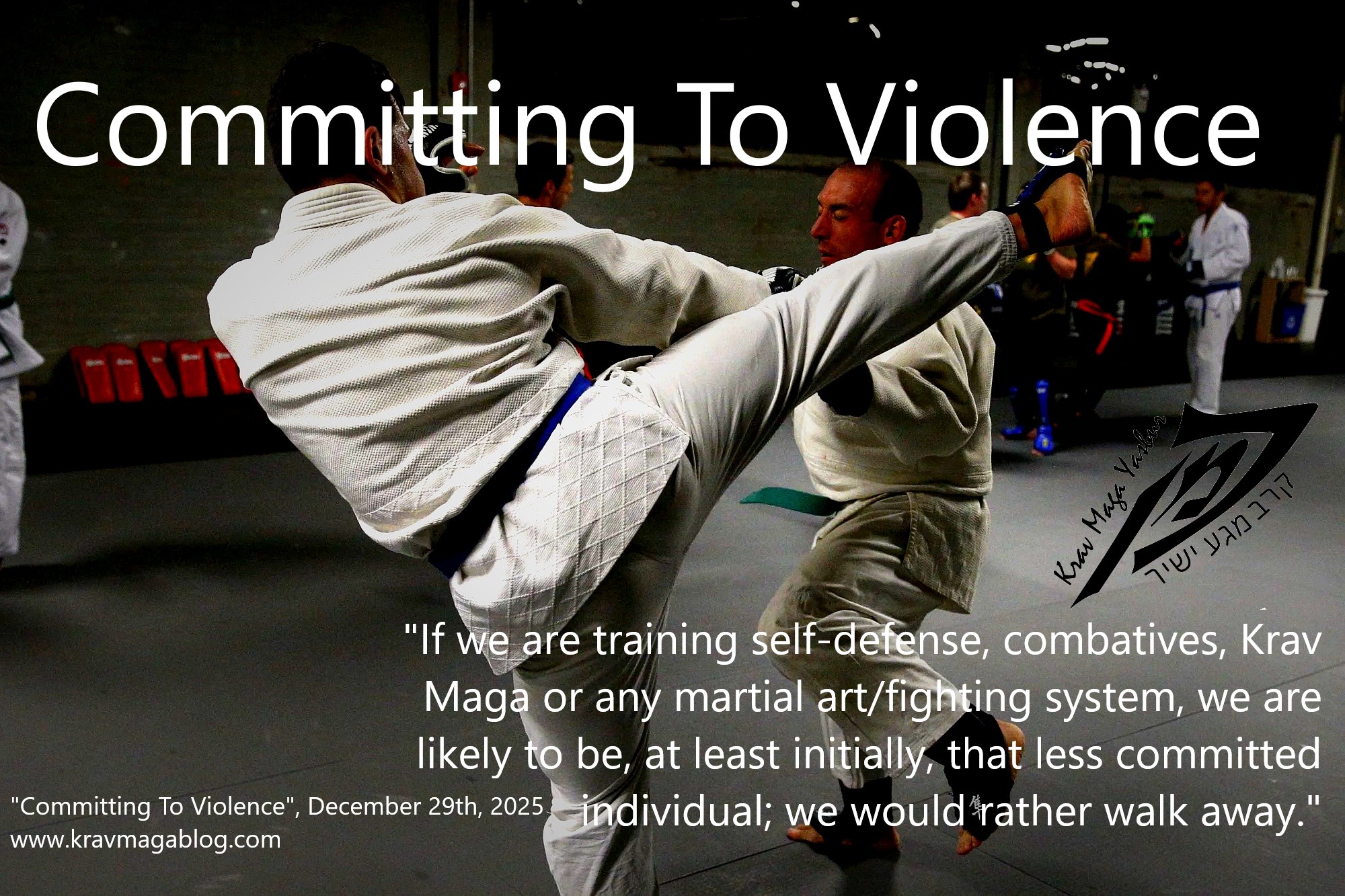
Real-world violence is usually non-consensual. Though it happens it is rare that both parties are equally committed to the fight, i.e., it is usually one person committing violence against another. If we are training self-defense, combatives, Krav Maga or any martial art/fighting system, we are likely to be, at least initially, that less committed individual; we would rather walk away. One of the things I always try to get over to my students when I am teaching de-escalation is that as you are trying to reduce and remove emotion from a verbal-confrontation, so that everyone can walk away unharmed, you are at the same time preparing for war, i.e., getting yourself ready to commit to violence. Just because an aggressor forces you to respond physically, doesn’t mean you should be less committed than they are. In fact, you should be more committed. Few people who get involved in fights are experienced, and if they are it is probably because they have enjoyed a level of success; probably because they committed to violence more than those they targeted, rather than because of any actual fighting ability etc. In my time working door security, I’ve dealt with many people who believed because of size and strength, or for whatever reason – including alcohol – that a physical confrontation would quickly/easily go their way. Most people are not used to being thrown/taken-down and when somebody’s balance is taken and they end up on the ground it is usually a sobering moment for them. For a throw (especially), or a punch to be effective you have to commit to it i.e., you have to commit to the violence of the action.
Your mindset, when dealing with real-life violence, should be – and this should be different to training/sparring – that every time you commit a physical action, it’s a violent one, intended to cause harm to the other person e.g., if you grab their arm, to set something up, the intention is that your “grab” causes pain and potentially harm; you aren’t just grabbing their arm in an emotional and physical vacuum, you are looking to damage them. You have to commit to violence. However, being able to commit to violence should not make you a violent person. You should walk away from any confrontation, depressed rather than euphoric i.e., you didn’t want to act violently towards another person(s) but their actions forced you to do so etc. This the crux of every legal self-defense claim; it’s an admittance of the use of violence because you had no other choice, other than to see yourself get harmed/injured/killed. No sane/rational person wants to cause harm to others, but when somebody wants to harm us, we should look to be able to meet their commitment to violence with our own. Whilst their commitment may be uncontrolled, ours shouldn’t be; when we recognize that we are no longer in imminent danger, and that we have an opportunity to disengage safely we should take it. Committing to violence does not mean the use of excessive force.