Author: Gershon Ben Keren
There is a tendency in Krav Maga and Self-Defense circles to treat all violence as being the same and equal and reducing everything down to the physical level e.g., a knife slash is the same as a knife stab, without attempting to understand how the context and motivation etc., precipitate and influence the nature of the assault. A slash with a knife, although it can be dealt with in the same way as a stab, contains a very different intent i.e., someone who is slashing is look to injure and cause harm, whilst someone stabbing is looking to cause serious injury and/or kill. This may be an emotional rather than conscious decision/choice, but it is an important one to understand e.g., someone slashing may be happy to see you disengage and no longer resemble a threat, whilst someone who is stabbing may continue to do so because they are so caught up in the emotion of the attack; they may not have started the conflict in this state but have found their emotions escalating because of it etc. It is also important to understand the nature of a verbal confrontation that will potentially turn physically violent because there may be an opportunity to de-escalate it, and this is where it can be useful to understand the three components that make up “momentary aggression”, a theory developed by social psychologists Paul A. M. van Lange and Eli Finkel.
The I³ Model they created/developed (pronounced "I-cubed") proposes that aggression is the result of the dynamic interaction of three forces/components: Instigation, Impellance, and Inhibition. The model assumes that whilst a person may have a predisposition to use violence in social interactions, they have not planned to engage in any violent act. They will only become aggressive due to a trigger/provocation i.e., there has to be an action and/or behavior that instigates an aggressive response. Impellance refers to the dispositional or situational pressure that intensifies the urge for a person to act/respond aggressively, whilst Inhibition concerns the internal and/or external mechanisms that are involved in suppressing aggression. Only when Instigation and Impellance overwhelm Inhibition will a person respond/act aggressively. This describes/explains why some people are more likely to become aggressive when triggered, i.e., they lack the Inhibition that prevents many from acting aggressively and they are more likely to be affected by dispositional or situational pressures/factors (Impellance).
To better understand the I³ Model we can use a simple example. For a person to become aggressive (when not motivated “internally” to do so, such as someone who commits a street robbery) there must be a “spark” or a “trigger”. This could be a verbal insult or challenge, it could be a perceived insult, and/or a physical act such as being pushed or having someone step intentionally or accidentally on their foot etc. This is what initially instigates a person’s aggressive response. Without instigation, aggression typically doesn’t occur, even in someone who may be predisposed to violence. However, just because someone perceives a slight or injustice doesn’t mean that they will respond to another individual aggressively e.g., they may mutter something under their breath as they walk away but they may choose not to verbally/physically confront the other person. One of the things that may affect their decision to do or not do so are dispositional and situational components/factors. If a person is drunk, they are more likely to react than if they were sober, and therefore more rational i.e., they can better consider and evaluate the potential consequences of their actions (dispositional factors). If they have friends present who have witnessed their slight or injustice, they may feel a certain amount of peer pressure to confront the other person (situational factors). Impellance reflects the internal and/or situational force that magnifies the reaction to the instigator explaining why someone might feel an urge/compulsion to retaliate.
Often in social interactions that have gone wrong we can identify and recognize the spark or trigger that has led to another person’s aggressive response, even if we don’t think/believe that it’s warranted. We can also usually recognize the dispositional and situational factors that might provide some fuel to the fire e.g., we can see that they are drunk and have friends who are egging them on etc. What we often have difficulty identifying is an individual’s level of inhibition i.e., how strong the “brakes” are that will prevent/stop them from acting/responding aggressively/violently. Factors such as good self-control, consideration of legal consequences and empathy are likely to inhibit an aggressive/violent response. High inhibition can override instigation and impellance, preventing violence. This is where it is important to understand context e.g., an individual who is insulted at a bar (instigation) and is already angry/touchy from a bad day at the office and feels disrespected due in part to being drunk and with peers who egg him on (impellance) and doesn’t think there will be real consequences to their actions (inhibition), decides to respond by throwing a punch at their perceived aggressor. If the context is now changed to a work setting where a colleague insults them in front of their boss/manager they are more likely to be inhibited from acting violently, as they will be aware of the consequences of doing so.
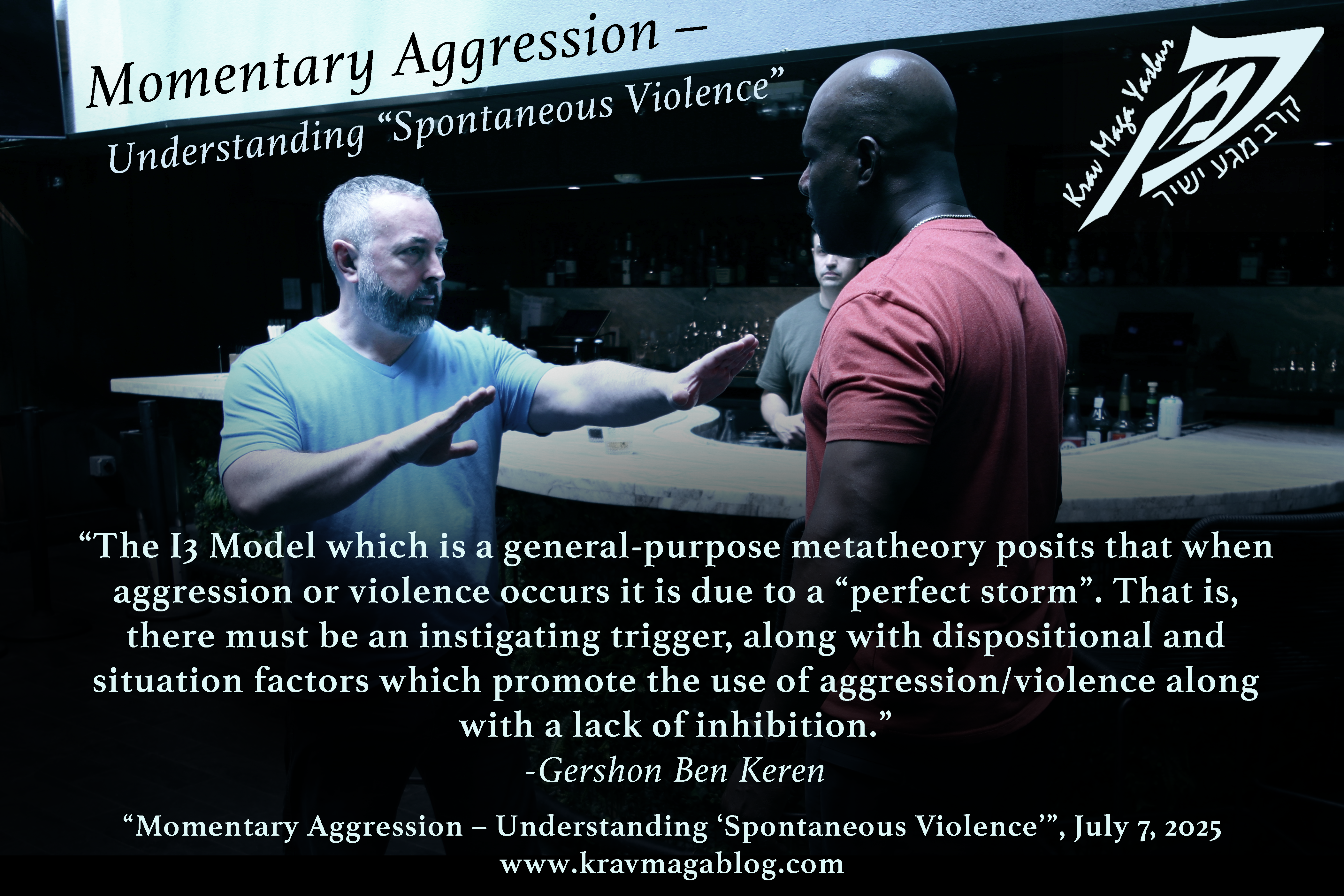
The I3 Model which is a general-purpose metatheory posits that when aggression or violence occurs it is due to a “perfect storm”. That is, there must be an instigating trigger, along with dispositional and situation factors which promote the use of aggression/violence along with a lack of inhibition. Inhibition can be the result of both internal and external factors, e.g., a lack of self-control (internal) and the risk of consequences for acting in this way (external). One of the reasons that the I3 Model is referred to as "I-cubed" is that it recognizes that aggression and violence is multi-dimensional, and that each of these three dimensions can interact to lesser or greater degrees in different directions. By trying to make sense of aggressive interactions considering these three things we can better understand whether de-escalation tactics/approaches are going to be successful or not.